


December 2025 - Week 2 Edition
It’s Time to Roll Over (or Establish) a Gold-based IRA for 2026
For much of the past century, it's been a tough time to invest in gold in America, with most gold coins and bullion being forbidden to own for 41 years, from 1934 to 1974, but as of the last day of 1974, gold was once again legal for Americans to own. In addition, from 1935 to 1974, most Americans’ retirement savings were limited to enforced Social Security payments “contributions,” reducing their take-home pay to invest in Treasury securities that were then used to pay off new retirees, rather than accruing in a savings account in their own name. All that changed in 1974 with the ERISA Act, which laid the foundation for tax-advantaged Individual Retirement Accounts in one’s own name.
These two trends came together to create the foundation for gold-funded IRAs, which are now an exceptional way to invest in gold (or silver) for your retirement, with tax advantages along the way.
Taxpayers have until April 15, 2026 to fund an IRA for tax-favored investments during the current calendar tax year, but it would help to open an IRA account as soon as convenient, with the assistance of one of our investment representatives to answer any questions and help you open such a self-directed IRA with a custodian who specializes in Gold IRAs (such as Equity Trust, a company we have worked for decades. You can then fund your IRA account through transfers, rollovers or direct contributions, storing your gold safely in an approved depository.
Here are your three easy steps to take, preferably this month, as part of your year-end tax planning.
-
CREATE AN ACCOUNT
-
TRANSFER FUNDS
-
BREATHE EASY, Then ENJOY RETIREMENT
1. CREATING AN ACCOUNT
A gold IRA is a self-directed individual retirement account (IRA) that allows you to invest in physical gold. Other precious metals, such as silver, platinum, and palladium, are also allowed in self-directed IRAs. A gold IRA offers the same tax benefits as a traditional IRA but gives you more control over your investment portfolio by allowing diversification into tangible assets.
Gold IRAs provide an opportunity to hedge against inflation, market volatility and economic uncertainty. Precious metals, like gold and silver, have historically maintained their value over time, making them a stable investment, particularly during times of financial turmoil or when traditional assets, like stocks, tend to underperform. To be eligible for a gold IRA allowing precious metals products, there are some minimum levels of metallic fineness and conditions that must be present.
The gold must be .995 fine, and silver must be .999 fine, with platinum and palladium being 99.95% fine, or pure. Gold Eagles, while only 22-karat (.917 fine), are also eligible.
Bars, rounds and coins must be produced to meet required fineness specifications and contain the name of the sovereign mint or a mint mark from a refiner, assayer or manufacturer that is accredited by the New York Mercantile Exchange, the New York Stock Exchange, the Commodities Exchange, the London Bullion Market Association or another major exchange.
A Gold IRA offers the same tax benefits as a traditional IRA or Roth IRA, but its value is backed by gold, not the value of a stock. Just like other IRAs, a Gold IRA offers tax-deferred contributions, which means you won’t pay taxes on the funds invested until you withdraw them in retirement. With a Roth Gold IRA, your contributions are made with after-tax dollars, so withdrawals are tax-free.
2. TRANSFERING FUNDS
You must transfer the physical gold (or silver) to a custodial account, meaning that you cannot take physical possession of your metals while they are in your IRA. The gold must be stored in an IRS-approved depository to maintain the IRA’s tax-advantaged status. Your precious metals are held in a high-security depository and insured by the depository against physical loss, damage or theft.
You will not be able to access the gold until retirement. If you withdraw any physical gold or silver, it will be considered a distribution and may be subject to taxes and penalties, depending on your age.
There are some fees involved, so you should consult with your representative about how we can help cover the first years of any fees you might be charged have for setting up a qualifying Gold IRA. These fees may include:
- Setup fees for opening your account
- Custodian fees for managing the Gold IRA
- Annual storage fees for holding your precious metals in an approved depository
- Transaction fees during the purchase or sale of precious metals
It is important to discuss these fees with your account representative to find out how you can qualify for free assistance from our company in meeting these obligations.
To fund your IRA account, you may roll over funds from your existing IRA, 401(k), 403(b), or existing retirement account, into a Gold IRA. This is usually done without incurring any taxes or penalties. Your account representative can guide you on exactly how and when you need to do this.
3. BREATHE EASY, THEN ENJOY RETIREMENT
When it comes time to retire and liquidate part or all of your account, the process is simple. Call your account representative to begin the process of selling your precious metals through your custodian, then withdraw the proceeds. Alternatively, you can take an “in-kind” distribution, which allows you to have your gold or other precious metals shipped directly to you. There may be tax implications, so you will want to discuss these options with your professional tax advisor. YOU SPENT YOUR LIFE BUILDING WEALTH, SO PLEASE TAKE 10 MINUTES TO PROTECT IT!
Why SILVER (and Platinum and Gold) Continue to Soar
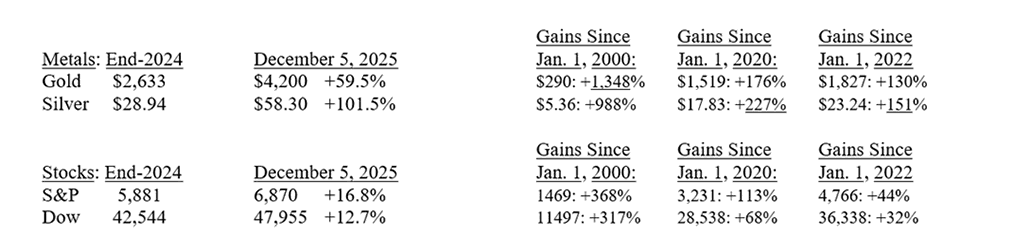
Silver has now doubled so far in 2025, while gold is “only” up 60% and platinum is up 85%, so it’s important to know that you can store any (or all) of these metals in a tax-advantaged precious metals IRA.
Part of the reason for the relative power of silver and platinum this year is that they trade in a narrower market than gold, with a far lower market capitalization than gold’s global market. Platinum and silver also have several industrial uses, while gold remains mostly a monetary metal.
New uses for silver include the manufacture of AI-based semiconductors and solar panels, among other tech-industry products.
The silver market has been in a supply deficit for five straight years now and new silver supplies from mines have been slowly shrinking over the last decade. Much of the new supply has come from recycling or melting coins, jewelry or silverware, in order to meet the rising demand. Silver prices are also rising over the possibility of future tariffs, after silver was added to the Geological Survey’s list of critical minerals last month. Stored trading supplies are also much lower, with inventories on the Shanghai Futures Exchange falling to their lowest level in a decade.
As a result of silver’s surge, the gold/silver ratio is down from 89-to-1 in August to 72-to-1 now. We can’t predict how low this ratio will go but we have always recommended owning precious metals in your portfolio and especially in your IRA.
Gold has traded over $4,000 per ounce for 30 days now, since November 10, after trading over $4,000 for only two weeks in October. So gold’s brief two-week correction, falling below $4,000 per ounce, was actually a way for investors to “buy on the dips,” as we advised at the time. Likewise, silver has traded over $50 per ounce since November 10th, after a brief correction below $50 in the same time frame as gold.
Silver has now more than doubled to $58+ per ounce from less than $29 an ounce at the start of 2025. Plus, silver has beaten the S&P 500 by 6-to-1 this year and gold has beaten the Dow by about 5-to-1 so far in 2025.
100% Customer Service Hotline - Toll Free: 877.877.2256
FREE AND FAST DELIVERY
Free delivery for all orders over $199
24/7 CUSTOMER SERVICE
Friendly 24/7 customer support
MONEY BACK GUARANTEE
We return money within 30 days